Credit & collateral
Margin lending, secured borrowing, shared collateral frameworks, interest models, position accounting, and asset onboarding.
- Lending
- Collateral
- Accounting
 Flying Tulip IncDiscuss a project
 Onchain financial infrastructure
Flying Tulip Inc designs and develops software for institutions building digital-asset credit, collateral, execution, settlement, and risk products.
For fintechs digital-asset institutions protocols asset managers exchanges
01 / Capabilities
Onchain prime brokerage brings together financing, collateral, execution, settlement, and risk management. We translate those interconnected requirements into production software—from smart contracts and pricing logic to APIs, operator tooling, and protocol integrations.
We can work alongside internal product, risk, and engineering teams or take responsibility for a clearly defined build.
Margin lending, secured borrowing, shared collateral frameworks, interest models, position accounting, and asset onboarding.
Cross-collateral and portfolio-margin systems, exposure limits, health calculations, liquidation design, and scenario testing.
RFQ workflows, quote signing, order routing, venue integrations, oracle inputs, and inventory controls.
Funding, carry, fees, P&L, closeouts, reconciliation, and reporting workflows across the full position lifecycle.
Smart contracts, backend services, APIs, indexers, SDKs, operator consoles, and client-facing applications.
Test strategy, invariants, simulations, access and upgrade controls, deployment tooling, audit preparation, and remediation support.
02 / System coverage
Prime brokerage products work only when markets, capital, controls, and infrastructure share one coherent design.
Engineering library
Architecture, tradeoffs, and failure modes across the prime brokerage stack. Technical resources for product, risk, and engineering teams.
Risk architecture
An engineering guide to crypto portfolio margin: scenario risk, collateral valuation, atomic checks, liquidation design and model validation.
Read engineering guideCredit infrastructure
An engineering guide to onchain lending: supply and debt accounting, liquidity, interest accrual, collateral controls and asynchronous redemption.
Read engineering guideExecution infrastructure
Designing an onchain RFQ engine: signed quotes, solver competition, atomic leverage, cancellation, inventory checks and liquidation execution.
Read engineering guideRisk and execution
Designing onchain liquidation systems with clear triggers, partial-closeout mathematics, RFQ and auction execution, backstops and residual-debt accounting.
Read engineering guideDerivatives infrastructure
An engineering guide to perpetual futures systems, covering position accounting, funding, oracle marks, liquidity limits and loss handling.
Read engineering guideSystem architecture
How to engineer a shared account, credit, margin, execution and settlement layer for digital asset prime brokerage workflows.
Read engineering guideEngineering practice
A technical development process for financial smart contracts: specifications, accounting invariants, permissions, testing, upgrades and deployment evidence.
Read engineering guideInstitutional infrastructure
How to engineer digital asset credit: eligibility, advance sizing, redemption registries, position locks, settlement reconciliation and shortfall controls.
Read engineering guideCollateral engineering
How to engineer cross-collateral accounts with asset eligibility, borrowing limits, concentration controls, settlement boundaries and reliable accounting.
Read engineering guideMarket data infrastructure
An engineering guide to price-oracle integration: valuation semantics, freshness, confidence, decimal normalization, fallback states and monitoring.
Read engineering guide03 / Engagements
From a discrete technical mandate to an embedded product team.
Architecture and engineering for a new onchain credit, trading, or prime brokerage product.
A defined subsystem such as an RFQ engine, margin framework, collateral module, or liquidation system.
Connect an existing product to new protocols, markets, venues, custody models, or data infrastructure.
Add a focused protocol and platform team alongside your internal product, risk, and engineering organization.
Institutional architecture
Explore the post-issuance liquidity, partner-instance, and settlement architecture behind the institutional work.
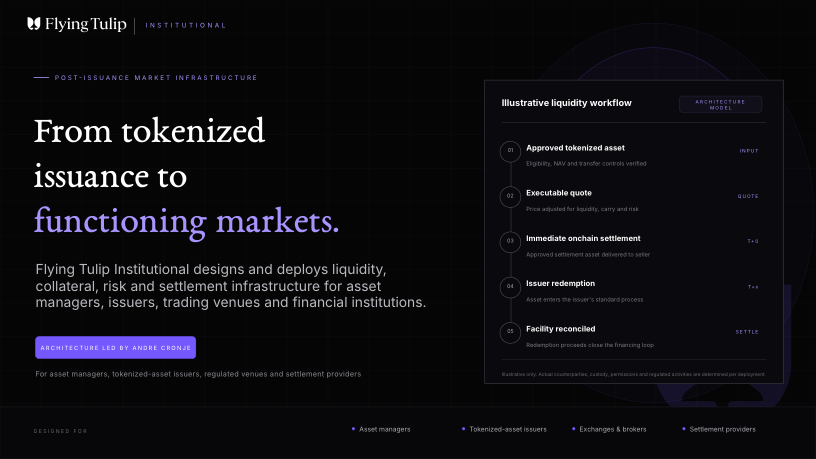
PDF · 12 pages · August 2026
A 12-page introduction to post-issuance liquidity, collateral, risk and settlement infrastructure for tokenized markets.
Discussion architecture. The source PDF preserves its dated market context and illustrative workflow; it does not establish current deployment availability or financial-service provision by FT Inc.
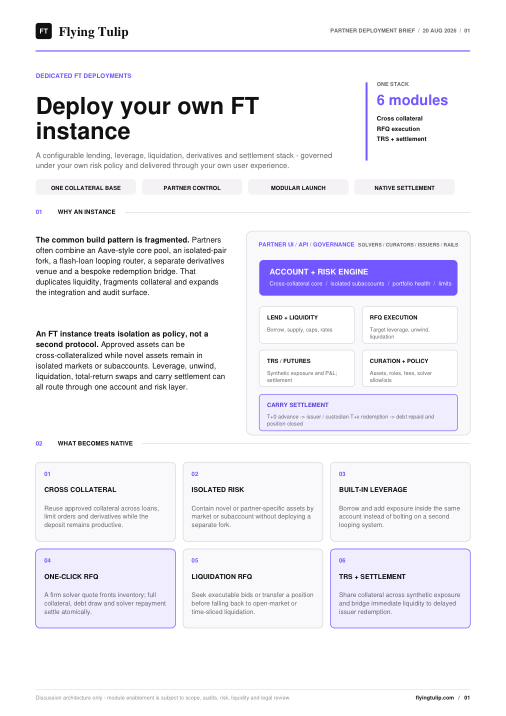
PDF · 3 pages · 20 August 2026
A three-page architecture proposal for a configurable account and risk layer connecting credit, execution, derivatives and carry settlement.
Discussion architecture. The source PDF includes dated product comparisons and proposed modules; enablement depends on scope, review, liquidity and the operating arrangement.
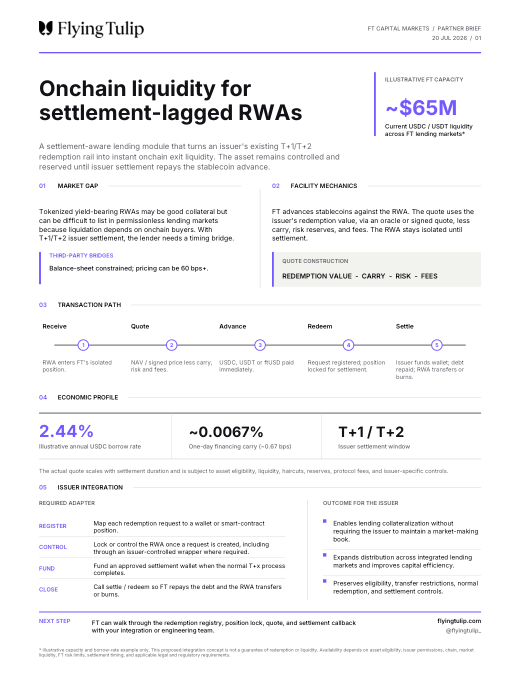
PDF · 1 page · 20 July 2026
A one-page proposed integration showing how a controlled tokenized asset can support an immediate advance while issuer redemption settles later.
Proposed integration concept. The source PDF retains dated, illustrative liquidity and rate figures; these are not current capacity, pricing, return or redemption commitments.
These source briefs describe architecture and proposed workflows. Availability, assets, capital, permissions, and operational responsibilities are established for each engagement. Figures in the original PDFs are dated illustrations, not current liquidity or pricing commitments.
04 / Process
Align on users, commercial objectives, assets, operating constraints, and risk requirements.
Mandate & requirementsEstablish system boundaries, specifications, interfaces, security assumptions, and milestones.
Architecture & specificationDeliver in reviewable increments with testing, documentation, and regular technical demonstrations.
Working production codeSupport integration testing, external review, deployment, rollout, and operational handover.
Hardened handover05 / Company
Flying Tulip Inc is the software development arm of the Flying Tulip ecosystem. Its mandate is broader than a single protocol: we work with third parties building their own digital-asset credit, execution, risk, and settlement products.
Engagements can be independent of the Flying Tulip protocol and designed around each client's architecture, venues, custody model, and operating requirements.
Related background: Andre Cronje’s public record and writing on market structure.
Start a technical conversation
Whether you are designing a new platform or extending an existing stack, we can help define and deliver the software behind it.
Discuss a project