Risk architecture
Portfolio margin architecture for crypto markets
An engineering guide to crypto portfolio margin: scenario risk, collateral valuation, atomic checks, liquidation design and model validation.
Read engineering guide Flying Tulip IncDiscuss a project
 Resources / Flying Tulip Inc
Technical guides, reproducible studies, and institutional briefs on the decisions that connect credit, collateral, execution, and settlement.
Original engineering evidence
A reproducible experiment with 18 closeout cases, 15 price shocks per case, and exact arithmetic. Read the findings, inspect the assumptions, and run the model.
Read the studyEngineering library
Architecture, tradeoffs, and failure modes across the prime brokerage stack. Technical resources for product, risk, and engineering teams.
Risk architecture
An engineering guide to crypto portfolio margin: scenario risk, collateral valuation, atomic checks, liquidation design and model validation.
Read engineering guideCredit infrastructure
An engineering guide to onchain lending: supply and debt accounting, liquidity, interest accrual, collateral controls and asynchronous redemption.
Read engineering guideExecution infrastructure
Designing an onchain RFQ engine: signed quotes, solver competition, atomic leverage, cancellation, inventory checks and liquidation execution.
Read engineering guideRisk and execution
Designing onchain liquidation systems with clear triggers, partial-closeout mathematics, RFQ and auction execution, backstops and residual-debt accounting.
Read engineering guideDerivatives infrastructure
An engineering guide to perpetual futures systems, covering position accounting, funding, oracle marks, liquidity limits and loss handling.
Read engineering guideSystem architecture
How to engineer a shared account, credit, margin, execution and settlement layer for digital asset prime brokerage workflows.
Read engineering guideEngineering practice
A technical development process for financial smart contracts: specifications, accounting invariants, permissions, testing, upgrades and deployment evidence.
Read engineering guideInstitutional infrastructure
How to engineer digital asset credit: eligibility, advance sizing, redemption registries, position locks, settlement reconciliation and shortfall controls.
Read engineering guideCollateral engineering
How to engineer cross-collateral accounts with asset eligibility, borrowing limits, concentration controls, settlement boundaries and reliable accounting.
Read engineering guideMarket data infrastructure
An engineering guide to price-oracle integration: valuation semantics, freshness, confidence, decimal normalization, fallback states and monitoring.
Read engineering guideInstitutional architecture
How to scope tokenized-asset infrastructure: liquidity and redemption workflows, deployment controls, responsibilities, validation and operating handover.
Read engineering guideInstitutional architecture
Explore the post-issuance liquidity, partner-instance, and settlement architecture behind the institutional work.
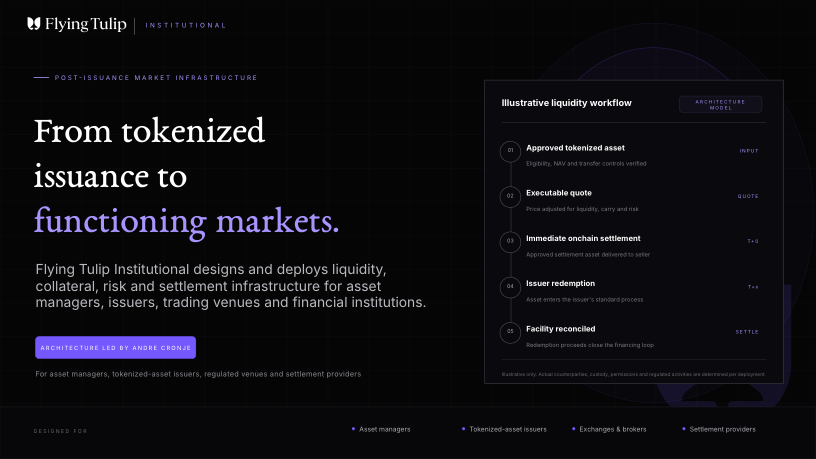
PDF · 12 pages · August 2026
A 12-page introduction to post-issuance liquidity, collateral, risk and settlement infrastructure for tokenized markets.
Discussion architecture. The source PDF preserves its dated market context and illustrative workflow; it does not establish current deployment availability or financial-service provision by FT Inc.
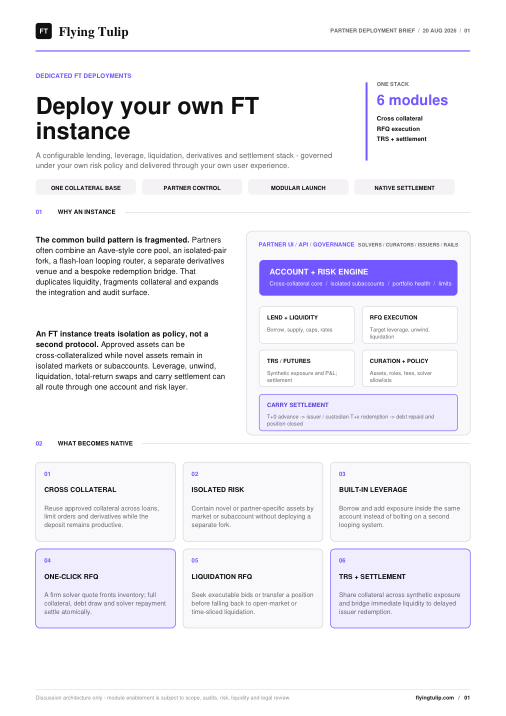
PDF · 3 pages · 20 August 2026
A three-page architecture proposal for a configurable account and risk layer connecting credit, execution, derivatives and carry settlement.
Discussion architecture. The source PDF includes dated product comparisons and proposed modules; enablement depends on scope, review, liquidity and the operating arrangement.
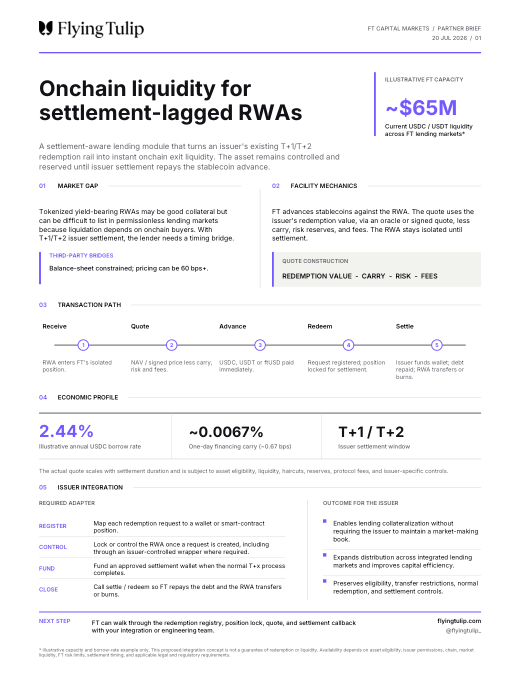
PDF · 1 page · 20 July 2026
A one-page proposed integration showing how a controlled tokenized asset can support an immediate advance while issuer redemption settles later.
Proposed integration concept. The source PDF retains dated, illustrative liquidity and rate figures; these are not current capacity, pricing, return or redemption commitments.
These source briefs describe architecture and proposed workflows. Availability, assets, capital, permissions, and operational responsibilities are established for each engagement. Figures in the original PDFs are dated illustrations, not current liquidity or pricing commitments.
Bring the assets, markets, and operating constraints. We can help turn them into a software architecture and a defined engineering engagement.